
There Is No Such Thing as a Normal Family

One of the things funeral celebrancy has reinforced for me is that there is no such thing as a normal family.
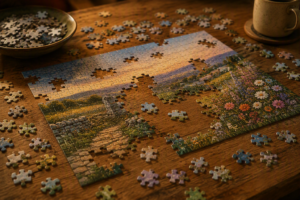
A partially completed jigsaw puzzle on a wooden table, with connected and unconnected pieces arranged around it.
Families rarely fit together neatly, but every family tells its own story.

It’s easy to look at other people’s lives and imagine that they are somehow simpler than our own. That other families don’t have tensions, disagreements, awkward histories or relationships that have become more complicated over time.

Yet when people begin talking about the person they have lost, a different picture often emerges.

Families are rarely straightforward

There are second marriages and blended families. Estranged siblings who haven’t spoken for years. Parent-child relationships that were loving, difficult, or sometimes both at the same time.

Former partners who remain important parts of the story. Friends who feel like family. Family members living on the other side of the world.

People trying their best to navigate old tensions whilst also grieving someone they loved.

In other words, families.

When someone dies, complexity doesn’t disappear

When someone dies, those complexities do not suddenly disappear. If anything, they can become more visible.

Different people may have different memories of the same person. They may have experienced different versions of them. They may have loved them deeply whilst also carrying hurts, disappointments or unfinished conversations.

The reality is that most lives are far too rich and complicated to fit neatly into a simple narrative.

Funerals don’t require perfect families

I think this is one reason why funerals matter.

At their best, they create space for honesty.

Not every story has to be polished. Not every relationship has to be described as perfect. Most families are not looking for perfection. They are looking for something that feels truthful.

What I often notice is that, beneath the details, people are usually trying to do the same thing.

They want the person they loved to be remembered well. They want the important stories to be told. They want others to understand something about who that person was.

They want to honour a life.

Sometimes that happens easily. Sometimes it requires patience, listening and careful conversation.

One of the privileges of this work is helping people navigate those conversations. Not by making differences disappear, but by creating space for different perspectives to exist alongside one another.

A different kind of normal

A funeral ceremony does not have to resolve every family difficulty.

It does not need to rewrite history.

It does not need to pretend that every relationship was straightforward.

What it can do is acknowledge a life honestly and create a moment where people come together to remember what matters to them.


This reflection sits alongside What Families Have Taught Me and Every Life Leaves Different Footprints, both of which explore the stories, relationships and memories that often shape funeral conversations.

If you’re planning a funeral, memorial ceremony or celebration of life, I’d be happy to help you tell the story of someone who mattered. You can find out more about my services or get in touch for an informal conversation.

Every Life Leaves Different Footprints

footsteps on an empty beach at sunset

When families talk to me about the people they have loved, I often hear concerns about getting the details right.

Did we remember every milestone?

Have we included all the achievements?

What if we forget something important?

These are understandable worries. When someone has died, it can feel as though we have been given the impossible task of summing up an entire life in a matter of minutes.

But over time I’ve noticed something.

The things people remember

The things that matter most are not always the things people expect.

Of course, careers, achievements and qualifications can be important parts of a life story. We often talk about the jobs people did, the businesses they built, the causes they supported, the places they travelled and the contributions they made.

Yet when families begin to share memories, the conversation often takes a different turn.

They talk about the Sunday dinners.

The terrible jokes.

The holiday that went wrong.

The way someone sang loudly and badly in the car.

The neighbour who could always be relied upon.

The grandparent who never missed a football match, a dance recital or a birthday.

The friend who somehow knew exactly when to pick up the phone.

The person who made everyone feel welcome.

The person who never quite learned how to use technology.

The person who could fix anything.

The person who always put the kettle on.

The footprints we leave behind

These are the things that rarely make headlines, but they leave an impression that can last for decades.

Every life leaves footprints.

Some are visible in careers, achievements and public contributions.

Others are found in conversations, acts of kindness, shared laughter and quiet moments that only a handful of people ever witnessed.

Neither is more important than the other.

Both tell us something about who a person was and the difference they made.

What families often teach me

One of the privileges of being a celebrant is hearing these stories.

Again and again, I am reminded that lives cannot be measured by a single standard.

What matters to one person may be entirely different from what matters to another.

Some people leave behind remarkable achievements.

Others leave behind remarkable relationships.

Most leave behind a mixture of both.

What people never forget

What families remember is not necessarily what someone did.

More often, it is how that person made them feel.

Loved.

Supported.

Encouraged.

Accepted.

Understood.

Funny.

Safe.

Valued.

Those impressions become part of the people who remain. They influence the stories we tell, the values we hold and the way we live our own lives.

Perhaps that is one reason funerals matter.

They give us the opportunity to pause and recognise the footprints someone has left behind. Not just the obvious ones, but the smaller, quieter marks that may have shaped the lives of others in ways they never fully realised.

Every life leaves different footprints.

And every set of footprints is worth remembering.


You may also enjoy What Families Have Taught Me and There’s No Such Thing As A Normal Family, both of which explore the stories, relationships and memories that often emerge when people begin talking about someone they love.

If you’re planning a funeral, memorial ceremony or celebration of life, I’d be happy to help you tell the story of someone who mattered. You can find out more about my services or get in touch for an informal conversation.